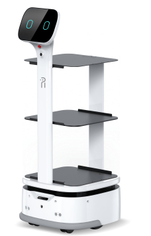
Restaurant service robot specific parameter
| product size | 541*531*1226(mm)(length*width*height) | |
| pallet dimension | 40*47.5cm(length*width) | |
| Product net weight(KG) | 60kg | |
| load(KG) | 60kg | |
| Maximum walking speed(M/s) | 0.5-1.2m/s | |
| Maximum climbing Angle<= | 5 | |
| Screen parameters | 10 inch Android screen | |
| sensor | Lidar, multiple 3D depth vision | |
| battery capacity(Ah) | 20ah | |
| rated power(W) | 50w | |
| working voltage(V) | 25V | |
| cruise duration(H) | 12h | |
| stand-by time(H) | 24h | |
| Working Environment (ground) | Indoor flat floor, carpet, cement floor Surface, tile floor, wood floor, etc | |
| Function and Technology Introduction | Fully autonomous positioning | Deep fusion of visual tag/LiDAR |
| Intelligent autonomous obstacle | Lidar, multiple 3D depth vision | |
| Welcome guests and voice prompts | Customized/Support for multiple languages | |
| Intelligent chat | Customized | |
Firstly, Restaurant service robots can provide personalized experiences to customers. These robots are programmed to recognize customers and greet them by their names. This makes customers feel valued and appreciated, which in turn enhances their dining experience. Moreover, the robot can also remember the customer's preferences and order history, enabling it to offer personalized recommendations and suggestions. This level of customization is something that traditional human servers cannot easily provide.
Secondly, service robots can save time and increase efficiency in restaurants. Human servers can take a while to attend to each customer and place orders, especially during peak hours. In contrast, service robots can take orders and deliver food much faster, freeing up human servers to focus on more complex tasks such as dealing with customer complaints and providing exceptional customer service. This not only saves time for customers but also ensures that the restaurant can serve more customers in a shorter amount of time.
Another advantage of using service robots in restaurants is their high level of hygiene. Traditional human servers may accidentally contaminate the food while handling it or even spread germs if they are sick. Service robots, on the other hand, are programmed to maintain a high level of sanitation and cleanliness. They eliminate the risk of contamination by using sterilized containers and taking extra care when handling food. This is especially important in today's times, where the COVID-19 pandemic has made hygiene an even more crucial aspect of the dining experience.
Furthermore, service robots can also enhance the restaurant's overall ambiance and theme. These robots can be customized to suit the restaurant's aesthetic and personality, making them an integral part of the overall dining experience. For instance, a Japanese restaurant may use robots resembling Geishas to welcome customers, while a futuristic restaurant may use robots with neon lights and metallic finishes.
In conclusion, service robots provide many benefits to restaurants looking to enhance their guest experience. From providing personalized service to saving time and increasing efficiency, service robots are a game-changer in the hospitality industry. They provide a unique dining experience that is sure to impress guests while also ensuring high levels of hygiene and safety. As more restaurants continue to embrace technology, we can expect to see an increase in the use of service robots across many other industries as well.
Hot Tags: restaurant service robot, China, suppliers, manufacturers, factory