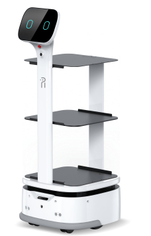
Food Service robots specific parameter
| product size | 565*537*1290(mm)(length*width*height) | |
| pallet dimension | 39*49cm(length*width) | |
| Product net weight(KG) | 57kg | |
| load(KG) | Each pallet 10kg | |
| Maximum walking speed(M/s) | 0.5-1.2M/s | |
| Maximum climbing Angle<= | 5 degree | |
| Screen parameters | 10 inch Android screen | |
| sensor | Lidar, 3D depth vision, touch | |
| battery capacity(Ah) | 20ah | |
| rated power(W) | 50w | |
| working voltage(V) | 25V | |
| cruise duration(H) | 12h | |
| stand-by time(H) | 24h | |
| Working Environment (ground) | Indoor flat floor, carpet, cement floor Surface, tile floor, wood floor, etc | |
| Function and Technology Introduction | Fully autonomous positioning and navigation | Deep fusion of visual tag/LiDAR |
| Intelligent autonomous obstacle | Lidar, multiple 3D depth vision | |
| Welcome guests and voice prompts | Customized/Support for multiple languages | |
| Intelligent chat | Customized | |
One of the most evident advantages of Food Service robot is that they can efficiently free up human staff, allowing them to focus on more essential tasks such as preparing and serving dishes. The robots can also assist with wait times by effortlessly delivering meals to tables, thus reducing the number of trips that servers have to make.
In addition, these machines offer an exciting way of modernizing the dining experience. Their sleek designs and innovative features make for a unique and memorable experience for customers. An added bonus is that they can also be programmed to assist with simple customer service issues, such as providing menu recommendations, answer frequently asked questions, or even sharing restaurant reviews.
Furthermore, the implementation of restaurant delivery robots in the food service industry is expected to lead to reduced operational costs, resulting in more affordable dining options for customers. By relying on these machines, restaurants can save on labor costs while maintaining efficiency in food delivery and service.
Another excellent application of these machines is the extension of indoor dining to outdoor spaces such as patios and sidewalk cafes. Traditionally, these areas have been more challenging to manage in terms of delivering food efficiently and safely. By using robots, customers can enjoy outdoor dining without the fear of food delivery complications or long wait times.
There are, however, some concerns about the impact of these machines on human labor in the food service industry. Restaurant staff members may feel threatened by automation, fearing that their jobs may be at risk. It is important to note, however, that restaurant delivery robots are not designed to replace human workers. Instead, they are meant to complement workers and improve service efficiency.
To sum up, the implementation of restaurant delivery robots in food service is a smart strategy for boosting customer service, improving operational efficiency, and adding value to dining experiences. While the advantages are clear, it is important to approach their integration thoughtfully and to ensure that the human aspect of customer service is not lost. By doing so, we can embrace the advantages of technology while still maintaining the value of human connection in the food service industry.
Hot Tags: food service robots, China, suppliers, manufacturers, factory