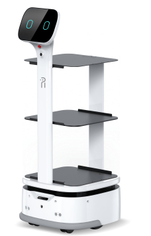
Food Serving Robot specific parameter
| product size | 565*537*1290(mm)(length*width*height) | |
| pallet dimension | 39*49cm(length*width) | |
| Product net weight(KG) | 57kg | |
| load(KG) | Each pallet 10kg | |
| Maximum walking speed(M/s) | 0.5-1.2M/s | |
| Maximum climbing Angle<= | 5 degree | |
| Screen parameters | 10 inch Android screen | |
| sensor | Lidar, 3D depth vision, touch | |
| battery capacity(Ah) | 20ah | |
| rated power(W) | 50w | |
| working voltage(V) | 25V | |
| cruise duration(H) | 12h | |
| stand-by time(H) | 24h | |
| Working Environment (ground) | Indoor flat floor, carpet, cement floor Surface, tile floor, wood floor, etc | |
| Function and Technology Introduction | Fully autonomous positioning and navigation | Deep fusion of visual tag/LiDAR |
| Intelligent autonomous obstacle | Lidar, multiple 3D depth vision | |
| Welcome guests and voice prompts | Customized/Support for multiple languages | |
| Intelligent chat | Customized | |
Food Serving Robots use a combination of sensors, cameras, and languages to navigate and deliver food to customers. These robots are equipped with GPS sensors, which help determine their location, and cameras that enable them to detect obstacles and avoid colliding with them. Moreover, they are programmed to understand languages and can communicate with customers.
The working principle of restaurant delivery robots is straightforward. Upon receiving an order, the food is prepared and placed inside a container, which is then placed on the robot. The robot is then programmed to navigate through the streets and find the customer's location. The robot's GPS sensors are activated, allowing it to locate the customer's address. Once the robot arrives at the customer's location, it emits a message indicating its arrival.
The customer then receives a notification on their phone, indicating that the robot has arrived. The customer is then instructed to enter a code or scan a QR code to open the container, allowing them to take their food. The robot waits a short period to ensure that the customer confirms delivery before returning to the restaurant.
Restaurant delivery robots are designed with safety in mind. They are equipped with sensors that enable them to detect obstacles and avoid collisions, making them safe to use in populated areas. Moreover, they are programmed to monitor their battery levels, and once their battery levels reach a certain point, they return to the restaurant for recharging.
In addition, restaurant delivery robots have been lauded for their efficiency and speed. Unlike human delivery personnel, these robots can navigate through crowded streets and deliver food quickly and accurately. They can also handle multiple deliveries simultaneously, saving time and reducing the workload for restaurants.
Furthermore, restaurant delivery robots are environmentally friendly. They use clean energy in the form of electric power, thereby reducing the carbon footprint of restaurants and delivery services.
In conclusion, restaurant delivery robots provide a new and exciting way of delivering food to customers. These robots offer numerous benefits, including efficiency, speed, and safety, making them an excellent addition to the food industry. With the advancement of technology, we can expect to see more innovations and improvements in food delivery services, making our lives easier and more comfortable.
Hot Tags: food serving robot, China, suppliers, manufacturers, factory