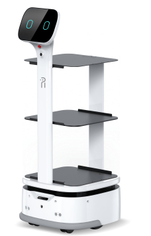
Food delivery robot
| product size | 541*531*1226(mm)(length*width*height) | |
| pallet dimension | 40*47.5cm(length*width) | |
| Product net weight(KG) | 60kg | |
| load(KG) | 60kg | |
| Maximum walking speed(M/s) | 0.5-1.2m/s | |
| Maximum climbing Angle<= | 5 | |
| Screen parameters | 10 inch Android screen | |
| sensor | Lidar, multiple 3D depth vision | |
| battery capacity(Ah) | 20ah | |
| rated power(W) | 50w | |
| working voltage(V) | 25V | |
| cruise duration(H) | 12h | |
| stand-by time(H) | 24h | |
| Working Environment (ground) | Indoor flat floor, carpet, cement floor Surface, tile floor, wood floor, etc | |
Another benefit of food delivery robots is that they are more reliable than human delivery persons. Robots never get tired, hungry, or distracted, and they can operate twenty-four hours a day, seven days a week. This means that customers can order food at any time of day or night, and they can always be sure that their food will arrive on time.
Food delivery robots are also more cost-effective than human delivery persons. While humans require wages, benefits, and medical insurance, robots only require maintenance and occasional repairs, making them a cost-efficient solution for businesses.
Moreover, food delivery robots are environmentally friendly. They do not require fuel, and they produce zero emissions, making them an excellent option for businesses looking to reduce their carbon footprint.
In conclusion, food delivery robots are a positive development that is set to revolutionize the way food is delivered. They are fast, reliable, cost-effective, and environmentally friendly, making them an ideal solution for businesses looking to enhance their delivery services. With their innovative technology and advanced capabilities, it is clear that food delivery robots are here to stay.
Hot Tags: food delivery robot, China, suppliers, manufacturers, factory