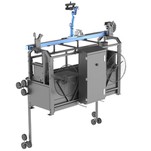
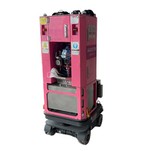
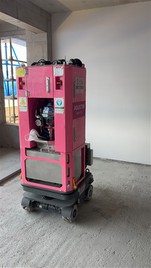
Ground Leveling Robot:
| Item | Parameter |
|---|---|
| Total weight | ≤ 500kg (no load) |
| Overall dimensions | 1400 × 1050 × 1800mm |
| Battery Capacity | 48V & 100Ah |
| Working endurance | ≥ 8h |
| Charging time | 4h (normal charge) |
| Working width | 2.8m (knife coating) / 3.8m (roller coating) |
| Coverage | 85% |
| Height of surmountable obstacle | ≤ 30mm |
| Width of surmountable trench | ≤ 50mm |
| Moving speed | ≤ 1m/s |
Ground Leveling Robot Application in Construction**
In the rapidly evolving world of construction, technology continues to pave the way for greater efficiency, precision, and safety. Among the groundbreaking innovations is the ground leveling robot, a marvel of automation that is transforming the process of applying cement in construction projects. This intelligent machine not only enhances the quality of work but also accelerates project timelines, making it an invaluable asset in the building industry.
Traditionally, the task of leveling ground and applying cement required significant manual labor, involving skilled workers who needed to ensure an even and smooth surface. This process could be time-consuming and physically demanding, often subject to human error or inconsistency. The introduction of the ground leveling robot addresses these challenges with remarkable effectiveness. Equipped with advanced sensors, GPS technology, and AI-driven algorithms, the robot can accurately assess the terrain and uniformly spread cement over large surfaces with minimal supervision.
One of the primary benefits of employing ground leveling robots in construction is the enhanced precision they bring. These robots are programmed to maintain exact levels and thicknesses, ensuring that the cement layer is perfectly even. This precision results in stronger foundations and smoother surfaces, which ultimately contribute to the longevity and safety of the structures being built. Moreover, the uniform application reduces the risk of imperfections such as cracks or uneven settling that can compromise the integrity of a building.
In addition to precision, ground leveling robots significantly improve operational efficiency. Their ability to work continuously without fatigue means that construction schedules can be shortened, helping companies meet tight deadlines while maintaining high-quality standards. This increased productivity also allows human workers to focus on more specialized tasks, fostering better resource allocation on job sites.
Another noteworthy advantage is the enhancement of workplace safety. Cement application can expose workers to dust, heavy equipment, and repetitive strain injuries. By automating the leveling and cement spreading process, these robots reduce the need for direct human involvement in potentially hazardous conditions, fostering a safer working environment.
The environmental impact of construction projects can also benefit from the use of ground leveling robots. Their precise application ensures minimal waste of materials, reducing excess cement usage and thereby lowering the ecological footprint. Additionally, the efficiency of these robots can contribute to energy savings on-site.
In conclusion, the integration of ground leveling robots into the construction industry marks a significant step forward in building technology. Their ability to combine precision, efficiency, safety, and sustainability makes them an excellent tool for modern construction projects. As these robots continue to advance, the future of construction promises to be smarter, faster, and more reliable, ultimately contributing to the creation of stronger infrastructures and improved living environments worldwide.
Hot Tags: ground leveling robot, China, suppliers, manufacturers, factory