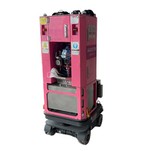
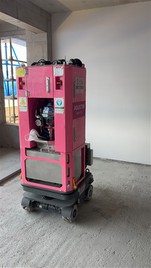
| Item | Exterior Wall Spraying Robot TR500 | Exterior Wall Spraying Robot TD500 |
|---|---|---|
| Overall dimensions | 3250×1700×2000 mm | 3250×1700×2000 mm |
| Total weight | 650 kg (no load)/950 kg (full load) | 650 kg (no load)/950 kg (full load) |
| Spray type | HP airless spraying | LP air spraying |
| Spraying media | Emulsion paint | Relief paint, colorful paint and natural stone paint |
| Net construction efficiency | 500 m²/h | 500 m²/h for relief paint and colorful paint, 300 m²/h for natural stone paint |
| Overall construction joint | 180 m²/h | 180 m²/h for relief paint and colorful paint, 100 m²/h for natural stone paint |
| Max. column width for spraying | 5000 mm | 5000 mm |
| Paint capacity | 200 L | 200 L |
| Power supply | 3-phase AC380V | 3-phase AC380V |
| IP Grade | IP54 | IP54 |
| Wind resistance | ≤ 8.3 m/s (force 5 wind) | ≤ 8.3 m/s (force 5 wind) |
The application of exterior wall spraying robots in the construction industry marks a transformative step towards greater efficiency, safety, and quality in building projects. These advanced robots are designed to autonomously perform spraying tasks on building exteriors, significantly enhancing the speed and precision of applying coatings such as paint, plaster, or insulation materials.
One of the most remarkable benefits of exterior wall spraying robots is their ability to improve work efficiency. Traditional wall spraying is labor-intensive and time-consuming, often requiring scaffolding and a large team to complete the job. In contrast, spraying robots can operate continuously with high accuracy, covering large surface areas in a shorter time frame. This acceleration not only shortens project durations but also reduces overall costs, making construction projects more economical and competitive.
Safety is another key advantage. Construction sites are inherently risky environments, and working at heights to spray building exteriors poses significant hazards. Spraying robots can be remotely controlled or programmed to work autonomously on high or hard-to-reach surfaces, minimizing the need for workers to be exposed to dangerous situations. This innovation helps in protecting laborers from potential falls or accidents, fostering a safer working environment.
In terms of quality, exterior wall spraying robots provide consistent and uniform application, which might be challenging to achieve manually. Their precise control systems ensure that coatings are applied evenly, reducing material waste and preventing defects such as streaks or uneven thickness. This consistency translates to aesthetically pleasing finishes and better performance in terms of insulation and durability, thus increasing the long-term value of the buildings.
Furthermore, the integration of smart technology in these robots enables real-time monitoring and adjustments, optimizing the spraying process according to environmental factors like wind speed or surface texture. This adaptability ensures that the coatings adhere well and perform optimally, even under varying site conditions.
The rise of exterior wall spraying robots also contributes to the broader trend of automation and digitalization in the construction industry, promoting sustainable practices. By minimizing material wastage and enhancing the efficiency of resource use, these robots support environmentally friendly construction methods.
In conclusion, exterior wall spraying robots represent a significant advancement in construction technology, offering improved efficiency, safety, and quality for building projects. Their adoption not only benefits contractors and workers but also results in higher-quality buildings and more sustainable practices. Embracing such innovative technologies will continue to drive the construction industry towards a smarter and more resilient future.
Hot Tags: exterior wall spraying robot, China, suppliers, manufacturers, factory